

Get the Right Care, in the Right Place

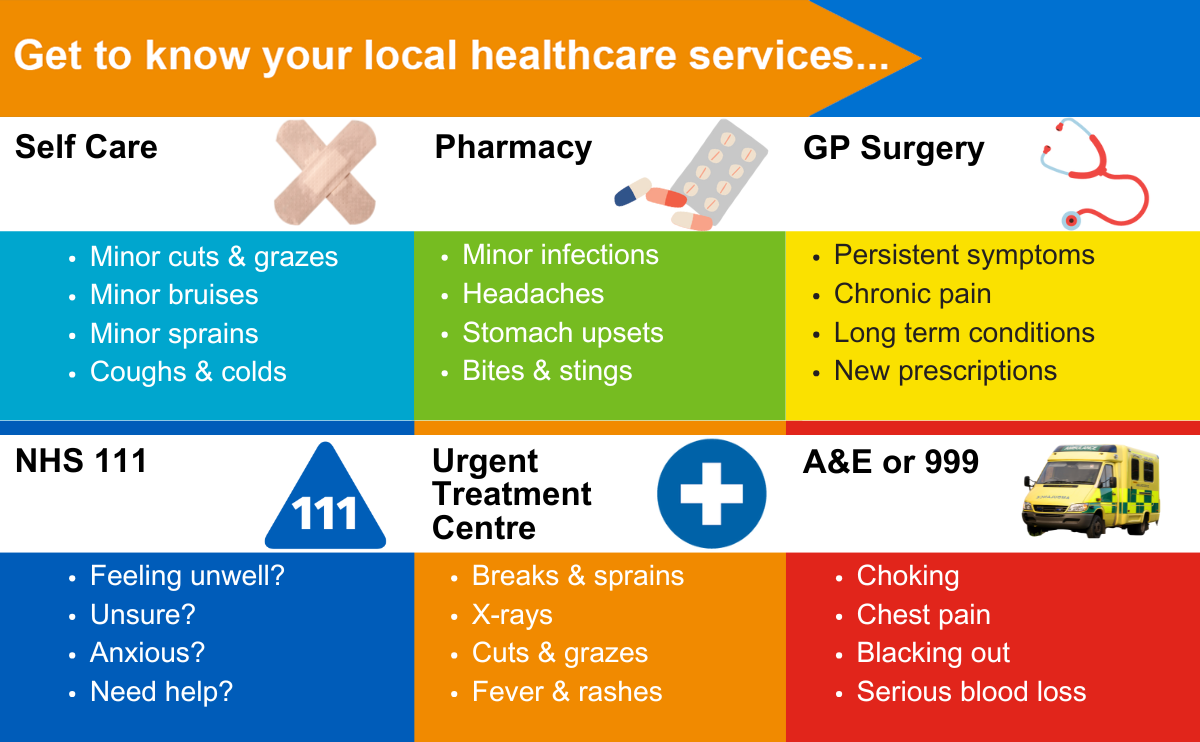

Residents in St Helens, Knowsley, Halton, Southport, Formby and West Lancashire who are in need of urgent – but not emergency care – are being asked to contact NHS 111 first, before travelling to hospital.
Use the online service: www.111.nhs.uk or freephone 111
Trained advisors are available 24/7 for urgent medical help or advice.
They can also arrange appointments for you to see the right health care professional in the right place.
111.nhs.uk can help you with:
- where to get help for your symptoms, if you’re not sure what to do
- how to find general health information and advice
- where to get an emergency supply of your prescribed medicine
- how to get a repeat prescription
- get emergency dental appointments

Your local pharmacy can provide expert advice and treatment for a range of minor illnesses without the need for a GP appointment. Pharmacists can assess and supply treatment, where appropriate, for conditions including earache, impetigo, infected insect bites, shingles, sinusitis, sore throat and some UTIs. They can also advise when you should see a doctor.
Find a pharmacy near you: NHS Pharmacy Finder.
Repeat Prescription Ordering
The NHS App is the quickest and easiest way to order repeat prescriptions, manage your medications, and choose your preferred pharmacy. You can also access your GP health record, view vaccinations, find your NHS number and more.
Ordering through the NHS App helps reduce unnecessary medicine waste by ensuring you only request what you need, when you need it. Remember to order your repeat prescriptions at least seven days before you run out to allow time for GP approval and pharmacy dispensing.
Download the NHS App from the Apple App Store or Google Play, or access it online at www.nhs.uk/nhs-app/account/. For support, visit nhs.uk/helpmeapp.

If you are feeling unwell with a non-urgent health concern, contact your GP practice.
All local GP practices are open and face-to-face appointments are available for those who need them. Evening and weekend appointments are also available across all areas.
Contact your local GP practice directly online or by telephone.

For urgent but non-life-threatening conditions, the right place is your local Urgent Treatment Centre or Walk-in Centre. They are open 7 days a week, 365 days a year, including bank holidays.
- St Helens Urgent Treatment Centre (Monday-Sunday, 8am-8pm): The Millennium Centre, Corporation St, St Helens, WA10 1HJ
- Runcorn Urgent Treatment Centre (Monday-Sunday, 8am-9pm): Nightingale Building, Hospital Way, Runcorn, WA7 2DA
- Widnes Urgent Treatment Centre (Monday-Sunday, 8am-9pm): Health Care Resource Centre, Caldwell Rd, Widnes, WA8 7GD
- Huyton NHS Walk-in Centre (Monday-Sunday, 8am-8pm): Nutgrove Villa, Westmorland Road, Huyton, L36 6GA
- Kirkby Urgent Treatment Centre (Monday-Sunday, 8am-8pm): St Chads Clinic, St Chads Drive, Kirkby, L32 8RE
- Halewood NHS Walk-in Centre (Monday-Sunday, 8am-8pm): The Halewood Centre, Roseheath Drive, Halewood, L26 9UH
- West Lancashire Urgent Treatment Centre (Monday-Sunday, 8am-8pm): Ormskirk District General Hospital, Wigan Road, Ormskirk, L39 2AZ
- Skelmersdale Walk-in Centre (Monday-Sunday, 8am-8pm): 116-118 The Concourse, WN8 6LJ
- Litherland Urgent Treatment Centre (Monday-Sunday, 8am-8pm): Litherland Town Hall Health Centre, Hatton Hill Road, Sefton, L21 9JN

Accident and Emergency (A&E) is for serious and life-threatening illnesses and injuries.
When you arrive, you will be assessed so we can understand your needs and make sure you receive the right care, in the right place.
Patients are seen according to how urgently they need treatment, rather than the order they arrive. This means someone who arrives after you may need to be seen first if their condition is more serious.
If your condition is not an emergency, there may be another NHS service that is better suited to your needs.

- Children's Symptom Checker - Is my child too ill for school?
Alder Hey Symptom Checker
Alder Hey Children’s Hospital has developed an online symptom checker to help parents and carers understand their poorly child’s symptoms and what they can do for them.
Using the Symptom Checker will help you decide where best to get the right care for your child. Get started at: www.alderhey.nhs.uk/conditions/symptoms-checker
Is my child too ill for school?
It can be tricky deciding whether or not to keep your child off school, nursery or playgroup when they're unwell.
Visit the 'Is my child too ill for school?' page on the NHS website.
- Mental Health and Wellbeing
If you are experiencing a mental health crisis or something that makes you feel severely unsafe, distressed, or worried about your mental health, you can now contact your local crisis service by calling NHS 111 and selecting option 2 (24 hours a day, 7 days a week).
Text support can be reached by messaging Shout, which is a free, confidential and 24/7 texting service. Simply text ‘Shout’ to 85258.
For young people aged 11 to 25, further support is available through Kooth offering self-help resources, online messaging and support.
Additionally, the Hub of Hope provides a directory of mental health support and services across the UK.
Hospital Mental Health Liaison Teams
These teams offer a 24 hour service based at the A&E departments in:
The teams provide support for people who are identified in A&E departments as having a mental health issue, as well as physical health problems.
Useful resources
- Looking after yourself - self care
During the year, you need to keep yourself well during and self treat minor illnesses (eg. cold/ sore throat), therefore freeing GP and hospital appointments for those who need them most. Help to stay well by following the top tips on this page to look after yourself and your family.
- Remember to order your repeat prescriptions well in advance so that you don’t run out!
- Speak to your pharmacist about what to keep in your medicine cabinet or search online for NHS medicine cabinet
- A basic first aid kit is essential, you can buy one in most pharmacies or supermarkets.
Home Medicine Cabinet
We suggest you keep the following:
- Paracetamol and aspirin (children under 16 and people with asthma should not take aspirin)
- Mild laxatives
- Anti-diarrhoeal medicines
- Rehydration mixture
- Indigestion remedy (for example, antacids)
- Travel sickness tablets
- Sunscreen – SPF15 or higher
- Sunburn treatment (for example, calamine)
- Tweezers and sharp scissors
- A thermometer
- A selection of plasters, non-absorbent cotton wool, elastic bandages and dressings
Remember:
- Keep the medicine chest in a secure, locked place out of reach of small children
- Always read the instructions and use the suggested dose
- Watch expiry dates – don’t keep or use medicines past their sell-by date
- Take all unwanted and out-of-date medicines back to the pharmacy
- Emergency Dental Treatment
If you need dental treatment in an emergency
- call a dentist: some surgeries offer urgent appointments at short notice
- if you do not have a dentist, find one by calling NHS 111
If you need to see a dentist out of hours
- call a dentist: their voicemail may advise where to get out-of-hours treatment
- call NHS 111 to find an out-of-hours dental service near you
Do not contact a GP, as they will not be able to offer emergency or out-of-hours dental care.
If you're in pain while waiting to see a dentist, take painkillers such as paracetamol or ibuprofen. NHS 111 can also offer other self-care advice.
Do you need urgent dental treatment?
Local dental providers offer NHS Urgent Dental Clinics with urgent appointments for patients who need urgent treatment, advise and support on dental queries or referral to other services.
If you need help with an urgent dental problem, call one of the helplines below, available from 9am to 9:30pm every day, including weekends and Bank Holidays.
Please note: this is an appointment only service - we do not operate a 'drop-in' service at any of our surgeries.
Dental Helplines
- In West Lancashire, call 0300 247 0054
- In Cheshire and Merseyside call 0161 476 9651
- Diarrhoea and Vomiting
Diarrhoea and vomiting are common in adults, children and babies. They are often caused by a stomach bug, such as norovirus, but can also occur as a result of other infections. Symptoms usually improve on their own within a few days.
Common symptoms include:
- Diarrhoea
- Vomiting
- Feeling sick (nausea)
- A high temperature (38°C or above)
- Headache
- Aching arms and legs
- General tiredness or feeling unwell
- Symptoms can start suddenly and may develop within 1 to 2 days of infection.
For more information, visit the NHS Website.